
by Karen Lindwall-Bourg | Oct 28, 2020 | Blog, Writing & Publishing
Roller Coaster of Grief
When I was younger, I loved riding roller coasters at the State Fair; I’d go every year with just enough money to buy lunch and ride the roller coaster a couple of times. But it wasn’t that way the very first time I rode one—my friends had to coax me on, and once it was over, they had to help me off!
Grief is often like a roller coaster ride.
Ups, Downs and Everything in Between
Life events are often a lot like that first roller coaster ride, especially when a loved one dies. Like that first coaster ride, with its ups, downs, twists, turns, smooth and rough spots—and not knowing what comes next—emotions and grief are unpredictable, and the feelings that come and go and change, can be confusing and scary.
Recently, I heard a news story about a roller coaster that stopped in mid-air. The riders hung upside down for three hours before the mechanics could repair the machinery and get them down. Can you imagine? Thankfully, no one was injured—but I bet it got them to thinking twice about riding that coaster again for a long while!
Unfortunately, when someone we love dies, we don’t have the choice to refuse the roller coaster ride of emotions. And “the death of someone we love is definitely not … a journey we would choose to go on.”
How to Ride the Roller Coaster of Grief
In Someone I Love Has Died: Get Me OFF This Emotional Roller Coaster Called Grief, author Karen Lindwall-Bourg walks us through her and her children’s own experiences after losing someone they loved. She helps the reader understand how different grief is for each person going through it; that all of the ups, downs and turn-arounds are completely normal; and that the ride WILL stop at some point. This booklet is for anyone struggling to understand that roller coaster called Grief. Children, parents, care-givers—anyone grieving the death of a loved one—will walk off that ride with renewed strength to carry on.

By Lee Desmond, originally posted on Rhema Publishing House

by Karen Lindwall-Bourg | Oct 28, 2020 | Blog, Writing & Publishing
Tyranny Of The Good
“Sometimes saying ‘No’ is the only way back to a life of ‘Yes.’” —Shauna Niequist
All things are lawful, but not all things are profitable. All things are lawful, but not all things build up.—I Corinthians 10:23
Good Things
Have there been times in your life, maybe even now, when you are doing good things—really good things, LOTS of good things—but you realize that something isn’t quite right? If you’re like me, the answer is a resounding “YES!” If we’re honest, most of us walk…or run really fast…that pathway more often than not. We get busy doing activities or jobs that are productive and helpful and serving others and life-giving. Why would we NOT want to do those things??
When our family moved from our beloved east Texas to Colorado several years ago, I felt that if I didn’t get involved and be of service and make friends pretty quickly, I might sink. We had left the place where we raised our children and ourselves; where we helped start a church, served in the community, and were involved in myriad home school activities; we left friends we did life with and with whom we developed roots. Because I had been doing all of these good things, before we got unpacked, I started putting my name on lists, volunteering for needs at church, and looking for people who were in the same life-vein as I was.
All of those things were good!

STOP! Slow Down!
But about a year after we got settled in CO, something—or Someone—spoke to me. “Slow down. Stop striving. Rest.” Then, “You will be just fine—even better. Get to know yourself and love those who are most important in your life right now. All of those other activities and needs and people aren’t going anywhere—but the most important ones are right in front of you. THIS is where you need to be.”
“STOP! Get to know yourself and love those who are most important in your life right now.” What?! Wasn’t I doing that? Hadn’t I done that all along? I was already doing that by staying busy with all the good things and people around us, while also teaching my children about service and what was important. What does that mean, “Get to know yourself”??
Tyranny of the Good
Somewhere along the way of life, where so many good things were before me, I thought I had to do them all and work to make sure things got done. I had to serve because there were so many needs, and surely, no one else would do the job; or because others expected me to do it; or maybe because it made me feel important. Really? Rather than pray over all of those good tasks (there’s a concept!) before deciding what was best for all concerned—especially my family andme—I took off running. I loved what I was doing: working, teaching, leading, heading up hospitality committees, attending to others’ needs.
Although I thought my busyness and service were necessary and good, they weren’t best. The work I was doing wasn’t always profitable—I was striving, and the good things I was doing became a kind of tyranny. The goodness of life, while always a gift, had started to become a very heavy weight; and before I realized it, I was on a track where knowing God, knowing myself, and knowing those I love most, had taken a back seat.
Saying No
Soon after I heard that voice telling me to slow down and “get to know myself” and to truly connect with and love those around me, I started saying “No.” I said No when I was asked to manage a website for something at church; No when a need was posted for a co-op leader; Nowhen asked to volunteer weekly at a food bank. All of these needs were important, necessary, and good—and it wasn’t easy using the N word (at first). But eventually, I gained a freedom that was even more important, necessary, meaningful—and so much better.
Gradually, I started saying Yes to quiet mornings at home, to writing more, to deep and important conversations with my adult children; Yes to serving those in my home. I had to learn No so I could get back to Yes.
In the process, I slowly began to realize things about myself and understand more of what God wanted me to know: that He will use me right where I am; I don’t need to chase after all of those good things in life I am not responsible for; He directs my path toward goodness as long as I seek Him first.

He who dwells in the shelter of the Most High
will abide in the shadow of the Almighty. Psalm 91:1
Return to your rest, my soul, for the Lord has been good to you. Psalm 116:7
Return to Your Rest
Once you find the Rest your soul needs, you’ll realize that Life is still there, all of those good things are still waiting. Eventually, you will also be able to discern what is profitable. When you’re able to step back and see not only what the world around you needs, but what YOU need, you’ll walk toward to a more healthy and whole path and will be able to say Yes once again.
“In returning and rest you shall be saved; in quietness and in trust shall be your strength.”
—Isaiah 30:15
By Lee Desmond, Originally Posted on Rhema Publishing House

by Karen Lindwall-Bourg | Oct 28, 2020 | Blog, Writing & Publishing
Never Give Up When Writing
Courage does not always roar. Sometimes courage is the quiet voice at the end of the day saying, “I will try again tomorrow.”
When my children were school age and were in the throes of writing and reading, we drove a couple of hours away so they could take part in a writing workshop, given by authors who had written children’s and youth literature—and who had been fairly successful. During one of the sessions about publishing (these were the days before self-publishing), the teacher commented that sometimes it takes awhile to get books published, but to never give up hope. He then mentioned a book we all knew very well; for ten years the author sent it to publisher after publisher, until one publishing house finally decided to take a chance.
If he had not persevered, we might have never had Frank Peretti’s This Present Darkness. Mr. Peretti may not have known at the time that his book would be a best-selling novel, but he did believe in the words he’d written—enough to have the courage to keep trying.
Never give up. Greatness might be just around the corner.
I have a friend who once wrote a curriculum for a class she was teaching. She asked several friends to read it so she could get feedback, because she was considering putting it into book format, hoping to sell it to a wider audience. The content wasn’t something I would have ever considered reading for pleasure or even education.
But one thing I had to remember: Other people would want to read it.
So I worked through the words on the paper; and when I finished reading it, I knew that once she reformatted it and reworked some of the content, the book just might be successful.
Little did I know just how successful.
That friend is now a well-known author; and that curriculum-turned-hardback-turned-paperback eventually became a series of books that sold into the millions. Because she believed in her work, she surrounded herself with people who would encourage her to persevere and seize the opportunities in front of her.

So here are some things to remember while writing that draft or handbook or curriculum or self-published book:
- See beyond the finished work. Know that one day it just may reach the audience that needs it.
- Surround yourself with people who will give honest and constructive feedback.
- Believe in your work! Know that what you say, what you write, is important and will benefit those who read it.
- Think about Frank Peretti and others who can inspire you to Never. Give. Up.
“And let us not grow weary of doing good, for in due season
we will reap, if we do not give up.”
Galations 6:9
Original Post By Lee Desmond from Rhema Publishing House
by Karen Lindwall-Bourg | Sep 4, 2020 | Blog, Celebrate Life!
11 Tips For Everyday Gratitude – Part 2
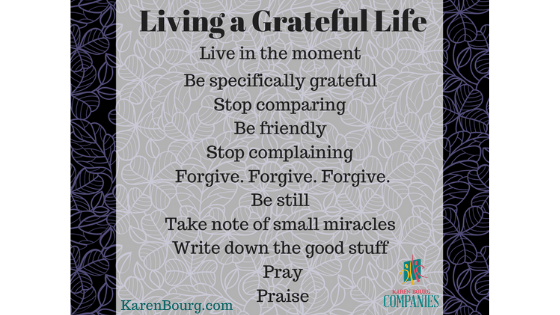
So how did you do? Have you found practical ways to implement everyday gratitude in your life? If you missed the first five tips, check them out in part 1…
For review, the first five tips for everyday gratitude are:
- Be in the moment.
- Be specifically grateful.
- Stop comparing.
- Be friendly.
- Stop complaining.
Gratitude Practice Tip #6 – Forgive. Forgive. Forgive.
Then Peter came up and said to him, “Lord, how often will my brother sin against me, and I forgive him? As many as seven times?” Jesus said to him, “I do not say to you seven times, but seventy times seven. Matt 18: 21-22
Nearly every time we are instructed to forgive, it comes along with a gentle reminder that we are greatly forgiven. Before we make an offering we are to forgive. Before we praise we are to forgive. And not just once. We are told to forgive the same offense over and over and over. Lest you think God doesn’t do the same for you, remind yourself of the things you struggle with and how many times you have made the same mistake. Over and over and over God forgives us. You do the same. And in all the forgiving you practice, don’t forget to include yourself. God has forgiven you, who are you not to forgive yourself?

Gratitude Practice Tip #7 – Be Still.
“Hear this, O Job; stop and consider the wondrous works of God. Job 37:4
The Lord will fight for you, and you have only to be silent.” Exodus 14:14
We are busy all year long. The new year is busy. Then it’s Easter. Then it’s summer. Then school starts again and the next thing you know it’s Christmas. Busyness is not a new thing for the children of God. It was just different then. God knew we would be busy – too busy to be still. Yet stillness is when you listen. It is in the stillness when God talks to you. It is in the stillness when you meditate — that’s what is means to consider the wondrous works of God.
I am especially fond to the verse in Exodus. After all, isn’t it when we are in the most distress when we try to handle things on our own and in our own strength. It’s usually when we make the biggest messes. The Lord will fight for you, just be still, be silent. Watch Him work.
Gratitude Practice Tip #8 – Take note of small miracles.
Are not two sparrows sold for a penny? And not one of them will fall to the ground apart from your Father. Matthew 10:29
Years ago there was a popular self-help/inspirational book titled “Don’t Sweat the Small Stuff”. Around the same time another book came out called “God is in the Small Stuff.” While, I never read either of these books, the titles speak volumes.
God cares for the sparrows. He cares for and adorns the flowers of the field. He knows the number of hairs on your head. If these are not the small things, I don’t know what is. These are part of the small miracles. It may seem silly to take note of the discount you got on the pair of shoes you’ve been eyeing. If God cares about the number of hairs on your head, if He knows the desires of your heart, if He cares when you stand or sit, don’t you think He cares about the shoes on your feet? The small miracles include when you spouse doesn’t get upset about something as usual because you’ve been praying. These are the small miracles of which to be grateful.
Gratitude Practice Tip #9 – Write down the good stuff
Come and hear, all you who fear God, and I will tell what he has done for my soul. Psalm 66:16
We overcome (the hard stuff) by the Blood of Jesus Christ and the word of our testimony. We are supposed to talk about what God has done for us. Granted some of it is personal and we are not anxious to broadcast it, but write it down. Write it down to remind you about it. Write it down so when you are ready to share, you remember all that God has done for your soul. Write it down to share with the next generations. How else would we know of Abraham, Isaac and Jacob?
Gratitude Practice Tip #10 – Pray.
Pray without ceasing 1 Thessalonians 5:17
Listen, if you can worry without ceasing you can pray without ceasing. If you can complain endlessly, you can pray endlessly. It is just that simple. When you find yourself worrying – PRAY. When you find yourself complaining, grumbling, or being frustrated – PRAY. When you find yourself happy and content – PRAY.
Gratitude Practice Tip #11 – Praise.
Give thanks to the Lord, for he is good, for his steadfast love endures forever. Give thanks to the God of gods, for his steadfast love endures forever. Give thanks to the Lord of lords, for his steadfast love endures forever; to him who alone does great wonders, for his steadfast love endures forever; to him who by understanding made the heavens, for his steadfast love endures forever; … Psalm 136:1-26
Admittedly, there are times when it feels super hard to praise. It feels like one of the most difficult things to do when you are in the middle of turmoil. Psalm 136 goes over reason after reason we should give thanks and praise. But, it boils down to one everlasting, unchangeable immovable truth – His steadfast love endures forever.
When there is no other reason to praise you count on this one thing – God’s love endures. No thing present, past or future can separate you from the love of God. No thing created, no thing under the sun will ever change the steadfast love of God.
In your practice of gratitude, don’t try to tackle all 11 tips. Start with just one or two and practice them for a month. Observe the way every day gratitude can impact your life, your attitude and your heart.
Blessings,
Karen Lindwall-Bourg
“Achieve Levels of Success Worth Celebrating”

*Founder, Karen Bourg Companies http://karenbourg.com
*Owner, President {Inter}National Association of Christian Women Entrepreneurs/International Christian Mompreneur Network http://nacwe.org
*Founder, RHEMA Publishing House http://rhemapublishinghouse.com
*Founder, RHEMA Lakeside Retreat Center https://www.facebook.com/rhemaretreat/
*Founder, RHEMA Counseling Associates http://rhemacounseling.com
About Karen Lindwall-Bourg
Karen Lindwall-Bourg is the President of the {Inter} National Association of Christian Women Entrepreneurs [est. May 2010] and the new President of the International Christian Mompreneur Network [est. July 2010], both at http://nacwe.org . She and the NACWE Operations and Leadership Teams work diligently to provide
· Community
· Networking
· Education
· Missions
opportunities to Christian Women Entrepreneurs, Mompreneurs and Nanapreneurs alike all over the world!
Our Core Values are
· Community – we value Connection, Collaboration and Contribution
· Networking – we value Nurture, New relationships and New and innovative offers
· Education – we value Encouragement, Excellence and Expressiveness, and
· Missions – we value Ministry and Making a difference
Karen is wife to Fred, Mommy to 6 kids and 5 in-loves, Nana to “going-on” 12 grandchildren, and treat provider deluxe for a herd of Great Pyrenees who protect their north TX ranch! She is an entrepreneur coach, author, publisher, retreat hostess and more! Learn more about Mastermind groups and “Celebration” coaching with Karen at http://karenbourg.com